We help shopping center owners across Ohio fill space faster — not by sending more flyers, but by giving prospective tenants the trade area research they need to say yes. Our team has supported portfolio-wide leasing reviews for one of the largest grocery-anchored owners in the country, and we apply the same methodology to single-asset repositionings in Columbus, Cleveland, Cincinnati, Dayton, Toledo, and the Ohio markets in between.

Ohio is a state of distinct retail submarkets, not a single market. A grocery-anchored center in Hilliard performs on completely different fundamentals than one in Mentor or Mason. National retailers know this, which is why their site committees push back on generic pitches — they want trade area data that reflects how the corridor actually behaves, not a demographic pull from a five-mile radius.
When a center sits with vacancy past 90 days, it's rarely a marketing problem. It's usually one of three things: the leasing narrative doesn't match what the retailer's real estate committee needs to see, the trade area story relies on stale data, or the center is being pitched to the wrong category of tenant entirely. We work with landlords to diagnose which of those is happening — and fix it.

Most leasing packages get skimmed. Research-grade trade area studies get read — because they answer the questions a retailer's real estate committee is going to ask anyway. We produce the same caliber of trade area work that national grocers use to underwrite new stores: drive-time analysis, daytime population, household income segmentation, competitive density, and corridor traffic patterns. When you put that in front of a prospective tenant, you move from a marketing pitch to a peer conversation.
If you're trying to attract a grocer, an off-price junior anchor, or a category-defining tenant to an Ohio site, we can build a sales forecast that estimates what that tenant would actually do at your location. We use the same gravity modeling platform the major grocers use, calibrated with field-verified store volumes from existing centers across the corridor. That forecast becomes the proof package that moves your site to the top of a retailer's review stack.
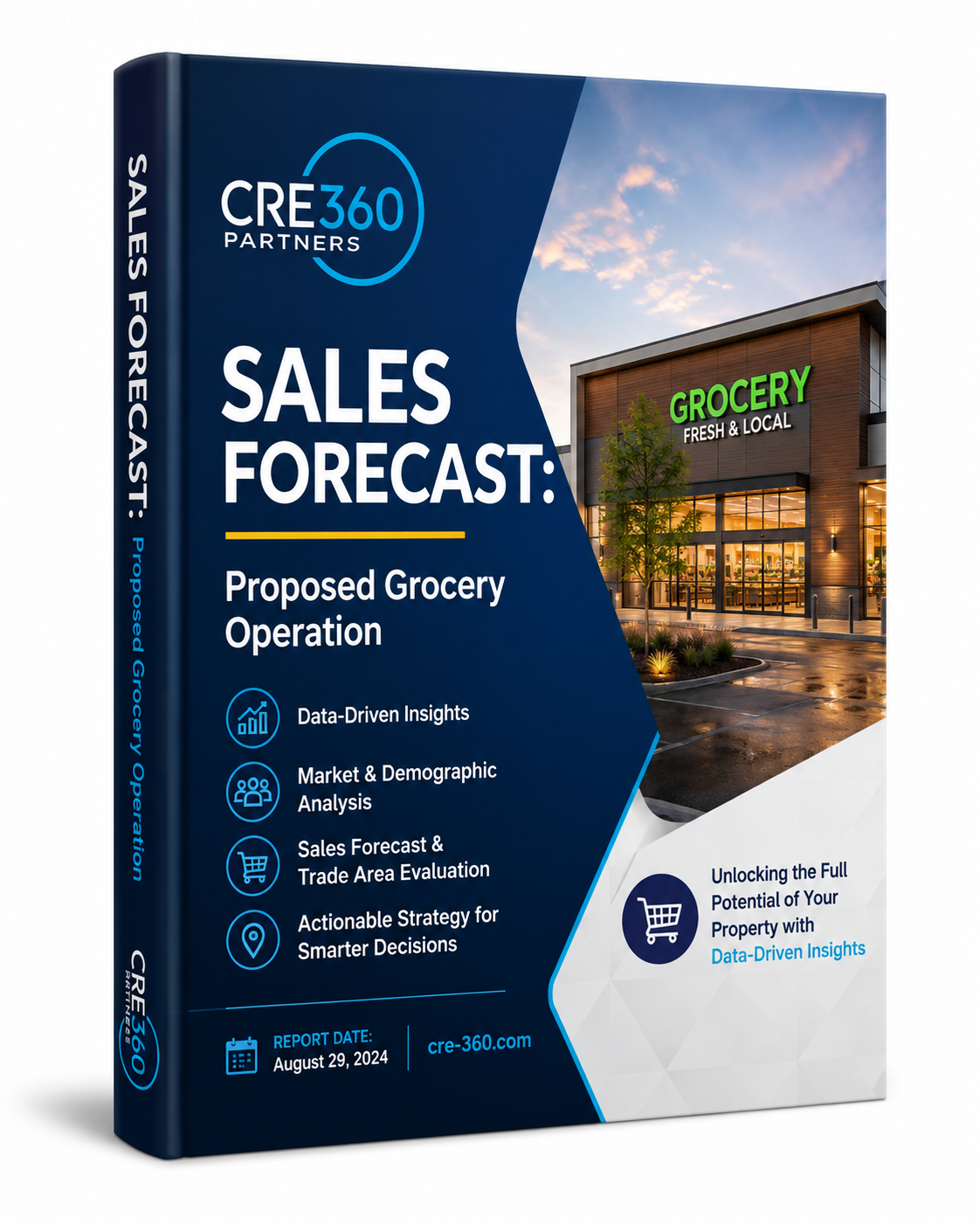

For owners with multiple Ohio assets, we run portfolio-wide reviews that identify which centers are leasing-ready, which need repositioning, and which are quietly losing share to newer product nearby. This is the same scope of work we delivered for First National Realty Partners across a 60+ center grocery-anchored portfolio — applied at whatever scale fits your holdings.
If a center has been on the market and the leasing activity has gone cold, we can tell you why — and whether the right move is a tenant category shift, a tenant mix rebuild, a redevelopment plan, or a hold. We have walked landlords away from chasing the wrong anchor and toward viable alternatives more than once. The case study on Kroger versus Sprouts/Grocery Outlet positioning is one example of that work.

See how CRE 360’s research team supported a Kroger repositioning effort that resulted in unlocking new tenant possibilities, and strengthening the developer/landlord’s negotiating positions.
Read Now →
Updated May 2026 - Ohio is being underwritten as a tier-two state, and that mispricing is the opportunity. National retailers who actually run the unit economics — Hibbett is one example — are finding that mid-sized Ohio markets deliver store-level performance that competes with suburbs of much larger MSAs. We have seen this firsthand across rollouts in Boardman, Lima, Mansfield, and other secondary corridors where the demographic-only screen says skip but the on-the-ground data says open.
That has direct implications for landlords. The retailers expanding into Ohio right now are not the household names from ten years ago. They are off-price apparel, specialty grocery, health and wellness formats, experiential concepts, and value-positioned QSR. If your leasing strategy is still calibrated to the 2018 tenant universe, the prospect list you're working from is incomplete.
We track expanding retailer announcements continuously, and we can tell you which national tenants are actively committed to growth in Ohio markets — and which of those would fit your asset profile.
We support a range of Ohio landlord engagements. Single-asset owners with a center that needs a tenant. Regional portfolios looking for an independent read on which centers are leasing-ready. Institutional owners using us as a research arm to validate internal leasing assumptions. Developers evaluating a new ground-up site against the existing competitive set.
Our research practice and transaction practice work together. If you need trade area research to support an existing leasing strategy, that's where we start. If you also need help executing on tenant outreach and lease negotiation, our transaction team handles that side — and the research informs every conversation. You can read more about our research methodology or how we approach transactions.
Get Started →

As Business Development Director at CRE-360, Sarah applies a results-driven, collaborative approach to driving growth, strengthening client relationships, and expanding new business opportunities. Sarah brings 18+ years of diversified real estate experience. Holding an MRED from George Mason University and her broker licenses in both Virginia and Florida, she has led brokerage operations, managed multifamily and commercial assets, and supported national brands with market research, site selection, and leasing strategy.
© 2026 CRE360 Partners. All rights reserved.
.png)